 Customer Support
 Contact Sales

 About
About


Affino AI: What 2025 Taught Us — and What We’re Building for 2026


 Discover Affino AI’s 2025 lessons shaping 2026 innovations.How Affino’s AI breakthroughs in 2025 fuel next year’s growth.Explore Affino’s AI evolution and bold plans for 2026.
At the start of 2025, we launched the first full iteration of Affino’s AI Suite. It was a major milestone for us — not because AI was new to Affino, but because it marked the moment when years of architectural work finally surfaced as customer-facing services.
2025 became a year of foundations, learning, and recalibration. And those lessons now shape everything we’re building for 2026.
A major Gen-4 launch - and a lot of learning
In Q1 2025, we released our Gen-4 Affino AI Suite, alongside a new Control Centre interface and significant upgrades to our ecommerce engine.
That release included:
- Editorial Co-Pilot (v1)
- Mass Content AI (bulk transformation at scale)
- Enhanced Chat and Assistant experiences
- The first phase of AI-driven automation
From a technical standpoint, this was a substantial step forward. Chat became faster, more fluid, and more controllable. Users could pause, redirect, and steer conversations rather than feeling locked into a single linear flow.
Critically, we also made AI available to guest users - essential for sales, marketing, and customer-service use cases. Doing that securely, at scale, without opening the door to abuse or performance degradation, required us to invest heavily in security, rate-limiting, and resilience from day one.
Hybrid search, automation, and large-scale content transformation
One of the strongest early outcomes was hybrid search. Rather than replacing traditional site search, we combined it with AI - letting keyword-based searches excel where they should, while AI handled questions, discovery, and contextual retrieval.
This proved far more effective than AI-only search. People still search differently depending on intent, and the hybrid approach respects that reality.
Alongside this, we introduced:
- Mass Content AI, capable of transforming hundreds of thousands (or millions) of articles at once
- Early-stage AI automation, triggering workflows based on keywords and sentiment within conversations
- These were deliberately pragmatic first steps - designed to observe how customers actually used AI, rather than assuming how they might.
- Choice, experimentation - and what actually worked
Early in the year, we gave customers a wide choice of LLMs and embeddings, including OpenAI, Claude, Mistral, AWS Titan, and others. We wanted real-world data, not theory.
The result was clear: nearly everyone converged on the same choices.
For most use cases, OpenAI models delivered the best balance of quality, speed, and cost. The lesson wasn’t that choice is bad - but that once people start building real workflows, consistency matters far more than optionality.
That insight directly informed our 2026 roadmap.
The adoption gap: AI isn’t traditional software
Perhaps the most important lesson of 2025 wasn’t technical — it was behavioural.
Many customers approached AI as if it were traditional software: configure it once, then expect predictable outcomes. AI doesn’t work that way. Prompts are the product.
We saw a clear pattern:
- Pilots often stalled for months
- Live deployments progressed quickly
Almost every issue was solvable through prompt refinement, not new features
In one case, a customer switched off a highly effective AI product assistant because it answered questions too well. Their concern was that it reduced page views.
The solution? One line in the prompt:
“Summarise, then direct users to the relevant directory pages for full details.”
That single change restored - and improved - their commercial model.
This pattern repeated again and again. The barrier wasn’t capability. It was confidence.
Reducing fear through structure
In response, we made a fundamental shift in how AI is configured in Affino.
Instead of single “mega-prompts”, we now separate concerns:
- Legal and compliance checks
- Editorial tone and structure
- Customer-service behaviour
- Organisational rules and boundaries
Each becomes its own reusable layer.
This allows:
- Legal teams to own compliance independently
- Editorial teams to define language and structure
- Customer-service teams to focus on outcomes
And critically, these layers change infrequently - removing fear while preserving flexibility.
Performance: the hardest problem in AI today
Across the industry, performance variability remains the biggest unsolved issue.
The same AI call can take 0.2 seconds one moment and 20+ seconds the next - with no meaningful SLA. That unpredictability makes it extremely difficult to build resilient user experiences.
We’ve responded by:
- Moving aggressively toward semantic search
- Introducing deep caching across AI services
- Shifting more work into asynchronous pre-processing
- Designing interfaces that surface value immediately, even before full responses complete
This isn’t “AI theatre” for its own sake - it’s about trust, transparency, and responsiveness.
Where AI genuinely exceeded expectations
Despite the challenges, AI in 2025 surpassed our expectations in key areas:
- Content understanding and summarisation
- Complex proposal review and sense-checking
- Support automation - now handling the majority of Affino support queries
- Image generation, which finally reached production-ready consistency
AI hasn’t replaced people at Affino - but it has added an extraordinary number of additional “eyes” to our work.
What we’re building in 2026
With these foundations in place, 2026 is about productising capability.
Our four major AI pillars for 2026 are:
1. AI Plugins (Q1)
Reusable AI services that can be embedded into any site or app, supported by deep integrations — including our upcoming Zapier launch, connecting Affino to over 8,000 platforms.
2. AI Analyst
A true breakthrough service. The AI Analyst processes structured and unstructured data, runs automations, and produces meaningful outputs - acting as an intelligence layer across Affino.
This would traditionally require millions of lines of code. We’re delivering it through layered AI architecture and automation.
3. AI Audio
2026 is the year of Affino AI Audio:
- Audio article summaries
- Spoken news briefings (5, 10, 30 minutes)
- Voice-based AI interaction
- Text had to be right first. Now audio makes sense.
4. CRM + AI
Once consistency and repeatability are nailed, AI-driven CRM workflows become transformative - and we’re laying the groundwork carefully, not recklessly.
A true foundation year
2025 wasn’t about hype. It was about infrastructure, behaviour, and truth-finding.
We’ve been architecting for AI for over six years. Some bets worked exceptionally well. Others didn’t, and we moved on quickly. That willingness to adapt is core to how Affino operates.
2026 builds on those foundations. And we’re confident the next generation of Affino AI services will be genuinely transformative for the community we serve.
Related
How does Affino's hybrid search improve user query accuracy and relevance?What benefits do layered AI prompt configurations provide for compliance teams?How will AI Plugins enhance integration across multiple platforms in 2026?In what ways does the AI Analyst automate data processing and insights?How does Affino AI Audio transform content consumption through voice interaction?Did you find this content useful?
Thank you for your input
Thank you for your feedback




Featured Blogs


Upcoming and Former Events
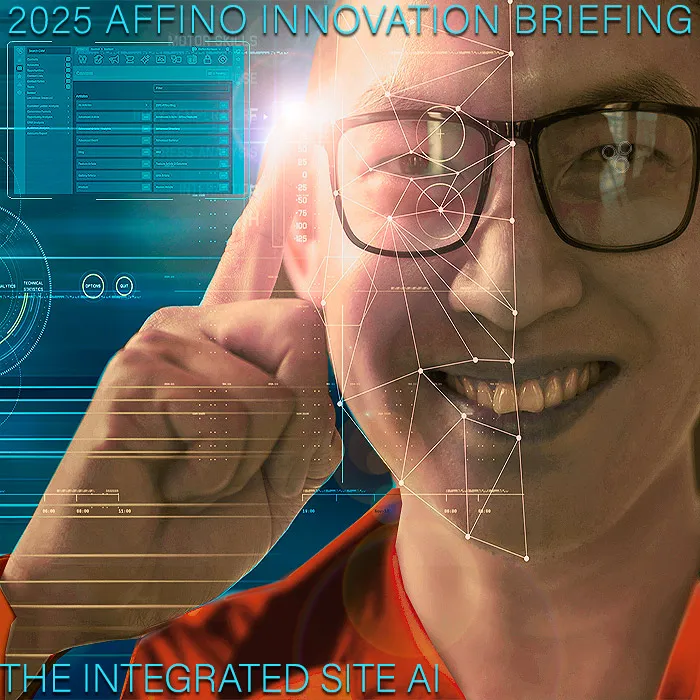
Affino Innovation Briefing 2025

Webinar - Affino Elevation Update Demo
Webinar - Introducing Affino's Fourth Generation AI Services

Webinar - Enhanced Affino Commerce & Subscription Capabilities
Affino Contacts

Markus Karlsson



Quang Luong

Stefan Karlsson

Driving business at some of the world's most forward thinking companies











Our Chosen Charity


Meetings:
Google Meet and Zoom
Venue:
Soho House, Soho Works +
Registered Office:
55 Bathurst Mews
London, UK
W2 2SB
© Affino 2026